
Machinery and materials
A question we are asked regularly: does my part fit with you? Below are the dimensions, the materials and the operations, so that you can see it at a glance.
Machines and working range
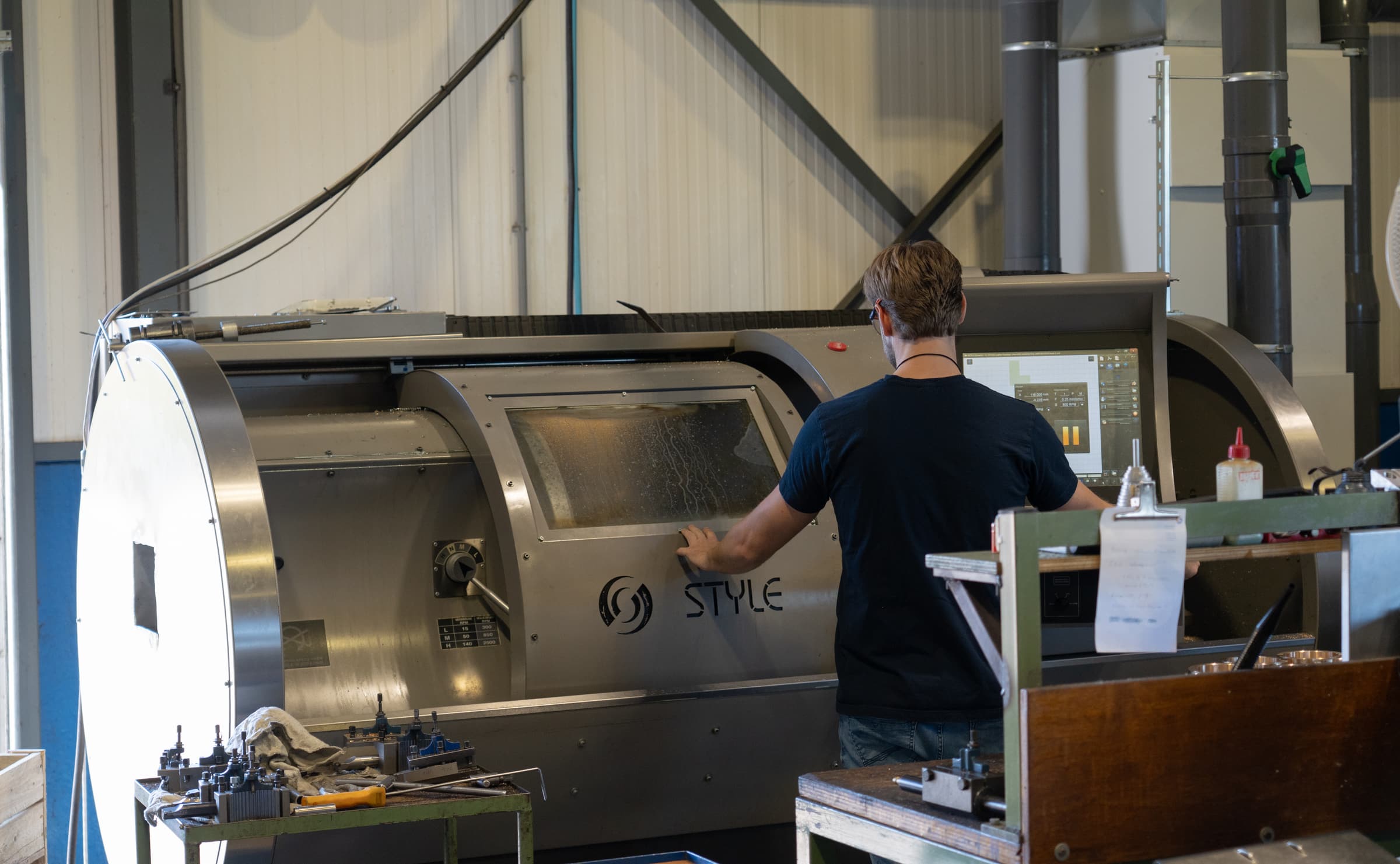
CNC where it can be done, conventional where that is faster or smarter. We deliberately have more machines than craftsmen, so that a rush job can start on a free machine straight away without planned work coming to a standstill.
CNC milling
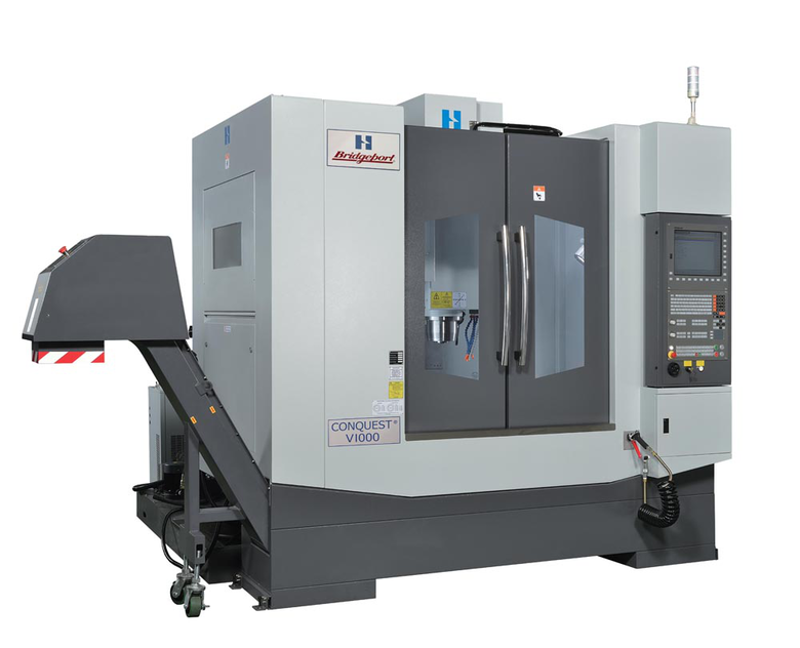
Four machining centres with Heidenhain control, two of them with a fourth axis. That allows us to machine several sides of a product without clamping it again, which saves time and reduces dimensional deviation.
- Number of machines
- 4
- Travels
- up to 1,020 x 610 x 610 mm
- Table size
- up to 1,200 x 600 mm
- Fourth axis
- on two machines
- Control
- Heidenhain TNC 530 and TNC 620
CNC turning and teach-in
Three lathes, two of them with teach-in control.
- Number of machines
- 3
- Maximum turning diameter
- 410 mm
- Maximum turning length
- 1,250 mm
- Spindle bore
- up to 82 mm
- Control
- Style 4.03 and Siemens Sinumerik
Conventional turning
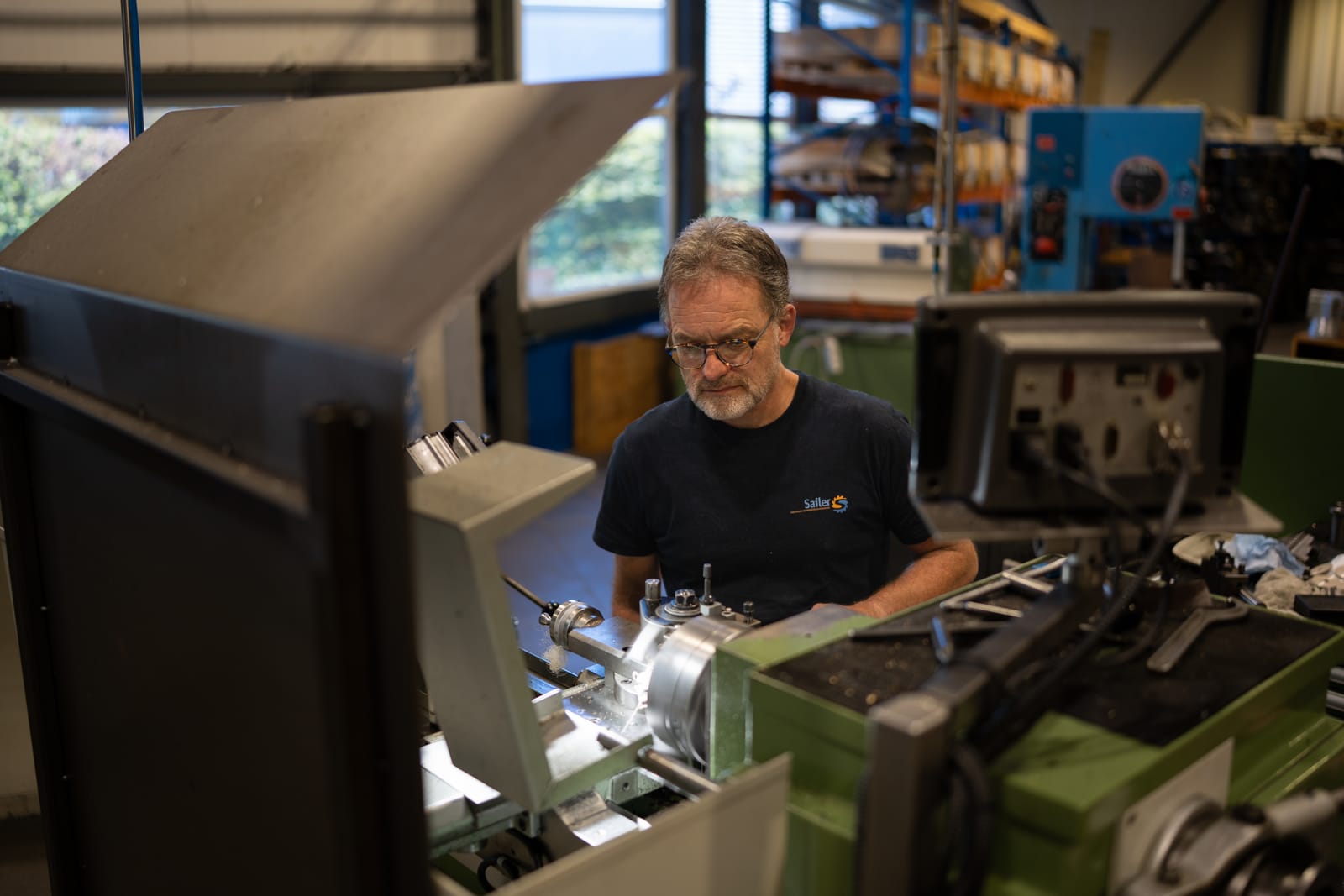
Five lathes, from fine instrument work to long shafts. We keep these machines on purpose: for a single piece, for a modification to an existing part and for rush work, a craftsman at a conventional lathe is often finished sooner than a programmer behind a screen.
- Number of machines
- 5
- Maximum turning diameter
- 500 mm
- Maximum turning length
- 1,500 mm
- Fine turning work
- from a few millimetres
Conventional milling
Three milling machines for smaller work, for reworking existing parts and for operations that can be done more efficiently on these machines than on a machining centre.
- Number of machines
- 3
- Travels
- up to 500 x 350 x 350 mm
- Table size
- 800 x 400 mm
Grinding, engraving and marking
Surface grinding for a flatness and surface roughness that milling does not reach, and a fibre laser for article numbers, serial numbers, scales and logos.
- Surface grinding
- magnetic table 400 x 160 mm
- Laser engraving
- fibre laser 50 watts
- Tool presetting
- Haimer, outside the machine
Measuring and inspection
Every product goes through the final inspection before it leaves the door. In our own inspection room we check the dimensions, and on request you receive the inspection report with the delivery.
- Profile projector
- Mitutoyo PJ-300
- Height gauge
- Mahr Digimar 817CLT
- Projector measuring range
- 505 x 705 x 405 mm
- Inspection report
- on request with the delivery
Materials
The overview below is based on the materials we have worked with most in recent years. Almost a third of it is stainless steel, steel and aluminium follow close behind, and plastics are a serious branch alongside. The most requested grades are on our rack as bar and plate, to keep lead times short.
Stainless steel
The material we machine most. We turn and mill shafts, bushes and flanges in 304 and the acid-resistant 316 every day, for food, water and process applications among others. Our specialists also know hardenable stainless and duplex well, with a 3.1 certificate if desired.
Structural and engineering steel
From bushes and spacer rings in bright structural steel to quenched and tempered shafts in 42CrMo4 and punch and mould parts in tool steel. Hardening and tempering run through regular partners; the grinding afterwards we often do ourselves.
Aluminium
The all-round 6082 T6 is our standard for frames, housings, fixtures and instrument parts. For precision plates that have to stay flat we use low-stress cast plate, and for light, highly loaded work the strong 7075. Anodising runs through a regular partner.
Engineering plastics
Plastics are a fully fledged branch alongside the metal here. POM for dimensionally stable sliding and guiding parts, PEEK for high temperatures, vacuum and medical applications, and wear-resistant or chemically resistant grades where the work calls for it.
Copper, bronze and brass
Bearing bushes, wear rings and sliding parts in bronze, also large and thick-walled from tube. Aluminium bronze we use for heavily loaded maritime work, with a 3.1 certificate if desired. Brass and copper we machine for small parts, feed-throughs and electrically conductive components.
Titanium and special alloys
We machine titanium regularly for instrument and research work: strong, light, corrosion-resistant and biocompatible. We also take on nickel alloys such as Monel, Hastelloy and Inconel. They are tough to machine, but our specialists know what these materials demand.
Is your material not listed? Feel free to ask. We machine metal and plastic on the same shop floor, so an assembly containing both is no problem for us either.
Where our limit lies
Being honest about what does not fit saves you and us time.
What we like to do
One-offs and series up to a few hundred, tight tolerances, difficult material combinations, rush work, and work in which the visible surface counts.
What suits another supplier better
Large series in which only the unit price counts, and heavy structural work outside our dimensions.
What we arrange around it
If an operation just does not fit on our machines, we outsource that part to a regular partner and you still keep one supplier, one delivery time and one invoice. With the final inspection and the quality you are used to from Sailer.
Curious what we make in your sector? View the sectors.
Not sure whether your part fits?
Send the drawing or the STEP file along with your request. If it does not fit, we will point that out and think along about an alternative.